I am glad i went through Oracle12c OCP exam yesterday and passed!
I went through Oracle training and read study material helped me to get through this exam.
This exam has two section.
Section 1 is New features of Oracle database 12c. Passing score is 64%. I scored 86%.
Section 2 is Key DBA skills. Passing score is 65%. I scored 90%.
Here are some sample OCP questions.
Question 1
A database is stored in Automatic storage management(ASM) disk group, disk group, DGROUP1
with SQL :
SQL > CREATE DISKGROUP dgroup1 NORMAL REDUNDANCY
FAILGROUP controller1 DISK '/devices/diska1','/devices/diska2'
FAILGROUP controller2 DISK '/devices/diskb1','/devices/diskb2';
There is enough free space in the disk gorup for mirroring to be done.
What happens if the CONTROLLER1 failure group becomes unavailable due to maintenance error?
Question 2
In your Multitenant container database(CDB) containing pluggable database(CDB), users complain about performance degradation.
How does real - time automatic database diagnostic monitor check performance degradation and provide solutions?
a) It collects data from SGA and compares it with a preserved snapshot.
b) It collects data from SGA, analyze it and provides a report.
c) It collects data from SGA and compares it with a latest snapshot.
d) It collects data from both SGA and PGA, analyze it and provides a report.
Question 3
Your Multitenant container database(CDB) has three pluggable database(PDB's) : PDB1,PDB2,PDB3.
Which two RMAN commands may be, used to backup only the PDB1 pluggable database?
a) BACKUP PLUGGABLE DATABASE PDB1 while connected to the root container.
b) BACKUP PLUGGABLE DATABASE PDB1 while connected to the PDB1 container.
c) BACKUP DATABASE while connected to the PDB1 container.
d) BACKUP DATABASE while connected to the boot container.
e) BACKUP PLUGGABLE database PDB1 while connected to PDB2.
The answer A and C.
Question 4
To enable the Database Smart Flash Cache, you configure the following parameters:
DB_FLASH_CACHE_FILE='/dev/flash_device_1','/dev/flash_device_2'
DB_FLASH_CACHE_SIZE=64G
What is the result when you start up the database instance?
a)It result in an error because these parameter settings are invalid
b)One 64G flash cache file will be used
c)Two 64G flash cache file will be used
d)Two 32G flash cache file will be used
The answer A
Question 5
Your database is running an ARCHIVELOG mode,
The following parameter are set in your database instance.
LOG_ARCHIVE_FORMAT=arch+%t_%r.arc
LOG_ARCHIVE_DEST_1='LOCATION=/disk1/archive'
DB_RECOVERY_FILE_DEST_SIZE=50G
DB_RECOVERY_FILE='/u01/oradata'
Which statement is true about the archived log redo files?
a)They are created only in the location specified by the LOG_ARCHIVE_DEST_1 parameter
b) They are created only in the Fast Recovery Area
c) They are created in the location specified by the LOG_ARCHIVE_DEST_1 parameter and in the default location $ORACLE_HOME/dbs/arch
d) They are created in the location specified by the DB_RECOVERY_FILE_DEST_1 parameter and location specified by DB_RECOVERY_FILE_DEST parameter.
The answer A
Question 6
Your multitenant container(CDB) contains two pluggable database(PDB), HR_PDB and ACCOUINTS_PDB, both of which use the CDB tablespace. The temp file is
called temp01.tmp.
A user issues a query on a table on one of the PDBs and receives the following error.
ERROR at line 1:
ORA-01565: error in identifying file '/u01/app/oracle/oradata/CDB1/temp01.tmp'
ORA-27037: unable to obtain file status
Identify two ways to rectify the error.
a) Add a new temp file to the temporary tablespace and drop the temp file that produced the error
b) Shut down the database instance, restore the temp01.tmp file from the backup, and then restart the database
c) Take the temporary tablespace offline, recover the missing temp file by applying redo logs, and then bring the temporary tablespace online
d) shutdown the database instance, restore and recover the temp file from the backup, and then open the database with RESETLOGS
e) shutdwon the database instance and then restart CDB and PDBs
The answer A and E.
Question 7
The persistent configuration settings for RMAN have defualt for all parameters.
Identify four RMAN commands that produce a multi-section backup.
a) BACKUP TABLESPACE SYSTEM SECTION SIZE 100M
b) BACKUP AS COPY TABLESPACE SYSTEM SECTION SIZE 100M
c) BACKUP ARCHIVELOG ALL SECTION SIZE 25M
d) BACKUP TABLESPACE "TEMP" SECTION SIZE 10M
e) BACKUP TABLESPACE "UNDO" INCLUDE CURRENT CONTROLFILE SECTION SIZE 100M
f) BACKUP SPFILE SECTION SIZE 1M
g) BACKUP INCREMENTAL LEVEL 0 TABLESPACE SYSAUX SECTION SIZE 100M
Question 8
Which two are prerequisite for performing a flashback transaction?
a) Flashback Database must be enabled
b) Undo retention guarantee for the database must be configure
c) EXECUTE privilege on the DBMS_FLASHBACK package must be granted to the user flashing back transaction
d) Supplemental logging must be enabled
e) Recycle bin must be enabled for the database
f) Block change tracking must be enabled for the database
Answer C and D
Question 9
Which three statements are true about Automatic Workload Repository(AWR)?
a) All AWR tables belong to the SYSTEM schema
b) The AWR data is stored in memory and in the database
c) The snapshots collected by AWR are used by the self tuning components in the database
d) AWR computes time model statistics based on time usage for activities, which are displayed in the v$SYS time model and V$SESS_TIME_MODEL views
e) AWR contains system wide tracing and logging information
Answer B, C and D
Question 10
Which three statements are true about using flashback database in a multitenant container database(CBD)?
a) The root container can be flashed back without flashing back the pluggable database(PDBs)
b) To enable flashback database, the CDB must be mounted.
c) Individual PDB's can be flashed back without flashing back the entire CDB
d) The DB_FLASHBACK RETENTION_TARGET parameter must be set to enable flashback of the CDB
e) A CDB can be flashed back specifying the desired target point in time or an SCN, but not a restore point
Answer B,D and E
Question 11
Which two statements are true when row archival management is enabled?
a) The ORA_ARCHIVE_STATE column visibility is controlled by the ROW ARCHIVAL VISIBILITY session parameter
b)The ORA_ARCHIVE_STATE column is updated manually or by a program that could reference activity tracking columns, to indicate that a row is no longer considered active.
c)The ROW ARCHIVAL VISIBILITY session parameter defaults to active rows only
d)The ORA_ARCHIVE_STATE column is visible if referenced in the select list of a query
e)The ORA_ARCHIVE_STATE column is updated automatically by the Oracle Server based on activity tracking columns, to indicate that a row is no longer considered active.
Answer C and D.
Question 12
Which Oracle Database component is audited by default if the unified Auditing Option is enabled?
a) Oracle Data Pump
b) Oracle Recovery Manager(RMAN)
c) Oracle Label Security
d) Oracle Database Vault
e) Oracle Real Application Security
Answer B
Question 13
Oracle Grid Infrastructure for a stand-alone server is installed on your production host before installing the Oracle Database server. The database and listener are configured by using oracle Restart.
Examine the following command and its output:
$ crsctl config has
CRS-4622: Oracle High Availability Services auto start is enabled.
What does this imply?
a) When you start an instance on a high with SQL *Plus dependent listeners and ASM disk groups are automatically started.
b) When a database instance is started by using the SRVCTL utility and listener startup fails, the instance is still started.
c) When database is created by using SQL * PLUS, it is automatically added to the Oracle Restart configuration.
d) When you create a database service by modifying the SERVICE_NAMES initialization parameter, it is automatically added to the Oracle Restart configuration.
Answer : B
Question 14
Which three statements are true regarding the use of the Database Migration Assistant for Unicode(DMU)?
a) A DBA can check specific tables with the DMU
b) The database to be migrated must be opened read-only
c)The release of the database to be converted can be any release since 9.2.0.8
d)The DMU can report columns that are too long in the converted characterset
e)The DMU can report columns that are not represented in the converted characterset.
Answer : A,D,E
Question 15
Your multitenant container database (CDB) contains a pluggable database, HR_PDB. The default
permanent tablespace in HR_PDB is USERDATA. The container database (CDB) is open and you
connect RMAN.
You want to issue the following RMAN command:
RMAN > BACKUP TABLESPACE hr_pdb:userdata;
Which task should you perform before issuing the command?
a)Place the root container in ARHCHIVELOG mode.
b)Take the user data tablespace offline.
c) Place the root container in the nomount stage.
d) Ensure that HR_PDB is open.
Answer : A
Question 16
Which three features work together, to allow a SQL statement to have different cursors for the same statement based on different selectivity ranges?
a) Bind Variable Peeking
b)SQL Plan Baselines
c) Adaptive Cursor Sharing
d) Bind variable used in a SQL statement
e) Literals in a SQL statement
Answer : A,C,E
Question 17
Which three statements are true about Oracle Data Pump export and import operations?
a) You can detach from a data pump export job and reattach later
b)Data pump uses parallel execution server processes to implement parallel import
c)Data pump import requires the import file to be a directory owned by the oracle owner
d)The Master table is the last object to be exported by the data pump
e) You can detach from a data pump import job and reattach later.
Answer : A,D,E
Question 18
Which three statements are true about adaptive SQL plan management?
a)It automatically performs verification or evolves non-accepted plans, in COMPREHENSIVE mode when they perform better than existing accepted plans.
b)The optimizer always uses the fixed plan, if the fixed plan exists in the plan baseline.
c)It adds new, better plans automatically as fixed plans to the baseline
d)The non-accepted plans are automatically accepted and become usable by the optimizer if they perform better than the existing accepted plans
e)The non-accepted plans in a SQL plan baseline are automatically evolved, in COMPREHENSIVE mode, during the nightly maintenance window and a persistent verification report is generated.
Answer : A,D,E
Question 19
On your Oracle 12c database, you invoked SQL * Loader to load data into the EMPLOYEES table in the HR schema by issuing the following command.
$> sqlldr hr/hr@pdb table=employees
which two statements are true regarding the command?
a)It succeeds with default settings if the EMPLOYEES table belonging to HR is already defined in the database
b) It fails because no SQL * Loader data file location is specified
c)It fails if the HR user does not have the CREATE ANY DIRECTORY privilege
d)It fails because no SQL * Loader control file location is specified.
Answers : A,C
Question 86
Question 87


I went through Oracle training and read study material helped me to get through this exam.
This exam has two section.
Section 1 is New features of Oracle database 12c. Passing score is 64%. I scored 86%.
Section 2 is Key DBA skills. Passing score is 65%. I scored 90%.
Here are some sample OCP questions.
Question 1
A database is stored in Automatic storage management(ASM) disk group, disk group, DGROUP1
with SQL :
SQL > CREATE DISKGROUP dgroup1 NORMAL REDUNDANCY
FAILGROUP controller1 DISK '/devices/diska1','/devices/diska2'
FAILGROUP controller2 DISK '/devices/diskb1','/devices/diskb2';
There is enough free space in the disk gorup for mirroring to be done.
What happens if the CONTROLLER1 failure group becomes unavailable due to maintenance error?
A) Transactions and queries accessing database objects contained in any tablespace stored in DGROUP1 will fail
B) Mirroring of allocation units will be done to ASM disks in the CONTROLLER2 failure group
until the CONTROLLER1 for failure group is brought back online.
C) The data in the CONTROLLER1 failure group is copied to the CONTROLLER2 failure group and re balancing is initiated.
D) ASM does not mirror any data until the controller failure group is brought back online, and newly allocated primary allocation unit (PA) are stored in the controller2 failure group without mirroring.
F) Transactions accessing database objects contained in any tablespace stored in DGROUP1 will fail
but queries will succeed.
The answer D
Question 2
In your Multitenant container database(CDB) containing pluggable database(CDB), users complain about performance degradation.
How does real - time automatic database diagnostic monitor check performance degradation and provide solutions?
a) It collects data from SGA and compares it with a preserved snapshot.
b) It collects data from SGA, analyze it and provides a report.
c) It collects data from SGA and compares it with a latest snapshot.
d) It collects data from both SGA and PGA, analyze it and provides a report.
The answer B
Question 3
Your Multitenant container database(CDB) has three pluggable database(PDB's) : PDB1,PDB2,PDB3.
Which two RMAN commands may be, used to backup only the PDB1 pluggable database?
a) BACKUP PLUGGABLE DATABASE PDB1 while connected to the root container.
b) BACKUP PLUGGABLE DATABASE PDB1 while connected to the PDB1 container.
c) BACKUP DATABASE while connected to the PDB1 container.
d) BACKUP DATABASE while connected to the boot container.
e) BACKUP PLUGGABLE database PDB1 while connected to PDB2.
The answer A and C.
Question 4
To enable the Database Smart Flash Cache, you configure the following parameters:
DB_FLASH_CACHE_FILE='/dev/flash_device_1','/dev/flash_device_2'
DB_FLASH_CACHE_SIZE=64G
What is the result when you start up the database instance?
a)It result in an error because these parameter settings are invalid
b)One 64G flash cache file will be used
c)Two 64G flash cache file will be used
d)Two 32G flash cache file will be used
The answer A
Question 5
Your database is running an ARCHIVELOG mode,
The following parameter are set in your database instance.
LOG_ARCHIVE_FORMAT=arch+%t_%r.arc
LOG_ARCHIVE_DEST_1='LOCATION=/disk1/archive'
DB_RECOVERY_FILE_DEST_SIZE=50G
DB_RECOVERY_FILE='/u01/oradata'
Which statement is true about the archived log redo files?
a)They are created only in the location specified by the LOG_ARCHIVE_DEST_1 parameter
b) They are created only in the Fast Recovery Area
c) They are created in the location specified by the LOG_ARCHIVE_DEST_1 parameter and in the default location $ORACLE_HOME/dbs/arch
d) They are created in the location specified by the DB_RECOVERY_FILE_DEST_1 parameter and location specified by DB_RECOVERY_FILE_DEST parameter.
The answer A
Question 6
Your multitenant container(CDB) contains two pluggable database(PDB), HR_PDB and ACCOUINTS_PDB, both of which use the CDB tablespace. The temp file is
called temp01.tmp.
A user issues a query on a table on one of the PDBs and receives the following error.
ERROR at line 1:
ORA-01565: error in identifying file '/u01/app/oracle/oradata/CDB1/temp01.tmp'
ORA-27037: unable to obtain file status
Identify two ways to rectify the error.
a) Add a new temp file to the temporary tablespace and drop the temp file that produced the error
b) Shut down the database instance, restore the temp01.tmp file from the backup, and then restart the database
c) Take the temporary tablespace offline, recover the missing temp file by applying redo logs, and then bring the temporary tablespace online
d) shutdown the database instance, restore and recover the temp file from the backup, and then open the database with RESETLOGS
e) shutdwon the database instance and then restart CDB and PDBs
The answer A and E.
Question 7
The persistent configuration settings for RMAN have defualt for all parameters.
Identify four RMAN commands that produce a multi-section backup.
a) BACKUP TABLESPACE SYSTEM SECTION SIZE 100M
b) BACKUP AS COPY TABLESPACE SYSTEM SECTION SIZE 100M
c) BACKUP ARCHIVELOG ALL SECTION SIZE 25M
d) BACKUP TABLESPACE "TEMP" SECTION SIZE 10M
e) BACKUP TABLESPACE "UNDO" INCLUDE CURRENT CONTROLFILE SECTION SIZE 100M
f) BACKUP SPFILE SECTION SIZE 1M
g) BACKUP INCREMENTAL LEVEL 0 TABLESPACE SYSAUX SECTION SIZE 100M
The answer A , B, E and G
Question 8
Which two are prerequisite for performing a flashback transaction?
a) Flashback Database must be enabled
b) Undo retention guarantee for the database must be configure
c) EXECUTE privilege on the DBMS_FLASHBACK package must be granted to the user flashing back transaction
d) Supplemental logging must be enabled
e) Recycle bin must be enabled for the database
f) Block change tracking must be enabled for the database
Answer C and D
Question 9
Which three statements are true about Automatic Workload Repository(AWR)?
a) All AWR tables belong to the SYSTEM schema
b) The AWR data is stored in memory and in the database
c) The snapshots collected by AWR are used by the self tuning components in the database
d) AWR computes time model statistics based on time usage for activities, which are displayed in the v$SYS time model and V$SESS_TIME_MODEL views
e) AWR contains system wide tracing and logging information
Answer B, C and D
Question 10
Which three statements are true about using flashback database in a multitenant container database(CBD)?
a) The root container can be flashed back without flashing back the pluggable database(PDBs)
b) To enable flashback database, the CDB must be mounted.
c) Individual PDB's can be flashed back without flashing back the entire CDB
d) The DB_FLASHBACK RETENTION_TARGET parameter must be set to enable flashback of the CDB
e) A CDB can be flashed back specifying the desired target point in time or an SCN, but not a restore point
Answer B,D and E
Which two statements are true when row archival management is enabled?
a) The ORA_ARCHIVE_STATE column visibility is controlled by the ROW ARCHIVAL VISIBILITY session parameter
b)The ORA_ARCHIVE_STATE column is updated manually or by a program that could reference activity tracking columns, to indicate that a row is no longer considered active.
c)The ROW ARCHIVAL VISIBILITY session parameter defaults to active rows only
d)The ORA_ARCHIVE_STATE column is visible if referenced in the select list of a query
e)The ORA_ARCHIVE_STATE column is updated automatically by the Oracle Server based on activity tracking columns, to indicate that a row is no longer considered active.
Answer C and D.
Question 12
Which Oracle Database component is audited by default if the unified Auditing Option is enabled?
a) Oracle Data Pump
b) Oracle Recovery Manager(RMAN)
c) Oracle Label Security
d) Oracle Database Vault
e) Oracle Real Application Security
Answer B
Question 13
Oracle Grid Infrastructure for a stand-alone server is installed on your production host before installing the Oracle Database server. The database and listener are configured by using oracle Restart.
Examine the following command and its output:
$ crsctl config has
CRS-4622: Oracle High Availability Services auto start is enabled.
What does this imply?
a) When you start an instance on a high with SQL *Plus dependent listeners and ASM disk groups are automatically started.
b) When a database instance is started by using the SRVCTL utility and listener startup fails, the instance is still started.
c) When database is created by using SQL * PLUS, it is automatically added to the Oracle Restart configuration.
d) When you create a database service by modifying the SERVICE_NAMES initialization parameter, it is automatically added to the Oracle Restart configuration.
Answer : B
Question 14
Which three statements are true regarding the use of the Database Migration Assistant for Unicode(DMU)?
a) A DBA can check specific tables with the DMU
b) The database to be migrated must be opened read-only
c)The release of the database to be converted can be any release since 9.2.0.8
d)The DMU can report columns that are too long in the converted characterset
e)The DMU can report columns that are not represented in the converted characterset.
Answer : A,D,E
Question 15
Your multitenant container database (CDB) contains a pluggable database, HR_PDB. The default
permanent tablespace in HR_PDB is USERDATA. The container database (CDB) is open and you
connect RMAN.
You want to issue the following RMAN command:
RMAN > BACKUP TABLESPACE hr_pdb:userdata;
Which task should you perform before issuing the command?
a)Place the root container in ARHCHIVELOG mode.
b)Take the user data tablespace offline.
c) Place the root container in the nomount stage.
d) Ensure that HR_PDB is open.
Answer : A
Question 16
Which three features work together, to allow a SQL statement to have different cursors for the same statement based on different selectivity ranges?
a) Bind Variable Peeking
b)SQL Plan Baselines
c) Adaptive Cursor Sharing
d) Bind variable used in a SQL statement
e) Literals in a SQL statement
Answer : A,C,E
Question 17
Which three statements are true about Oracle Data Pump export and import operations?
a) You can detach from a data pump export job and reattach later
b)Data pump uses parallel execution server processes to implement parallel import
c)Data pump import requires the import file to be a directory owned by the oracle owner
d)The Master table is the last object to be exported by the data pump
e) You can detach from a data pump import job and reattach later.
Answer : A,D,E
Question 18
Which three statements are true about adaptive SQL plan management?
a)It automatically performs verification or evolves non-accepted plans, in COMPREHENSIVE mode when they perform better than existing accepted plans.
b)The optimizer always uses the fixed plan, if the fixed plan exists in the plan baseline.
c)It adds new, better plans automatically as fixed plans to the baseline
d)The non-accepted plans are automatically accepted and become usable by the optimizer if they perform better than the existing accepted plans
e)The non-accepted plans in a SQL plan baseline are automatically evolved, in COMPREHENSIVE mode, during the nightly maintenance window and a persistent verification report is generated.
Answer : A,D,E
Question 19
On your Oracle 12c database, you invoked SQL * Loader to load data into the EMPLOYEES table in the HR schema by issuing the following command.
$> sqlldr hr/hr@pdb table=employees
which two statements are true regarding the command?
a)It succeeds with default settings if the EMPLOYEES table belonging to HR is already defined in the database
b) It fails because no SQL * Loader data file location is specified
c)It fails if the HR user does not have the CREATE ANY DIRECTORY privilege
d)It fails because no SQL * Loader control file location is specified.
Answers : A,C
Question 20
You plan to Migrate your database from a file system to ASM on same platform.
Which two methods or commands would you use to accomplish this task?
a)RMAN convert command
b)Data Pump Export and import
c)Conventional Export and Import
d)The BACKUP AS COPY DATABASE... command of RMAN
e)DBMS_FILE_TRANSFER with transportable tablespace
Question 21
Which two statements are true about the RMAN validate database command?
a)It checks the database for intrablock corruptions
b)It can detect corrupt pfiles
c)It can detect corrupt spfiles
d)It checks the database for interblock corruptions
e)It can detect corrupt block change tracking files
Question 22
Your multitenant container database, CDB1, is running in ARCHIVELOG mode and has two pluggable databases, HR_PDB and ACCOUNTS_PDB. An RMAN backup exists for the database.
You issue the command to open ACCOUNTS_PDB and find that the USERDATA.DBF data file for the default permanent tablespace USERDATA belonging to ACCOUNTS_PDB is corrupted.
What should you do before executing the commands to retore and recover the data in ACCOUNTS_PDB?
a)Place CDB1 in the mount stage and then the USERDATA tablespace offline in ACCOUNTS_PDB
b)Place CDB1 in the mount stage and issue the
ALTER PLUGGABLE DATABASE accounts_pdb CLOSE IMMEDIATE command.
c)Issue the ALTER PLUGGABLE DATABASE accounts_pdb RESTRICTED command
d)Take the USERDATA tablespace offline in ACCOUNTS_PDB
Question 23
You use a recovery catalog for maintaining your database backups.
You execute the following command:
$rman TARGET/CATALOG rman/cat@catdb
RMAN> BACKUP VALIDATE DATABASE ARCHIVELOG ALL;
Which two statements are true?
a)Corrupted blocks, if any are repaired
b)Checks are performed for physical corruptions
c)Checks are performed for logical corruptions
d)Checks are performed to confirm whether all database files exists in correct locations
e)backup sets containing both data files and archive logs are created.
Question 24
You notice a performance change in your production oracle database and you want to know which change has made this performance difference.
You generate the compare period Automatic Database Diagnostic Monitor(ADDM) report to further investigation.
Which three findings would you get from the report?
a)It detects any configuration change that caused a performance difference in both time period.
b)It identifies any workload change that caused a performance difference in both time period.
c)It detects the top wait events causing performance degradation.
d)It shows the resource usage for CPU, memory, and I/O in both time periods.
e)It shows the difference in the size of memory pools in both time period,
f)It gives information about statistics collection in both time periods.
Question 25
Which three statements are true about SQL plan directives?
a)They are tied to specific statement or SQL ID.
b)They instruct the maintenance job to collect missing statistics or perform dynamic sampling to generate a more optimal plan.
c)They used to gather only missing statistics.
d)They are created for a query expression where statistics are missing or the cardinality estimates by the optimizer are incorrect.
e)They instruct the optimizer to create only column group statistics.
f)Improve plan accuracy by persisting both compilation and execution statistics in the SYSAUX tablespace.
Question 26
Which four actions are possible during an online Data file Move operations?
a)Creating and dropping tables in the data file being moved.
b)Performing file shrink of the data file being moved.
c)Querying tables in the data file being moved.
d)Performing Block Media Recovery for a data block in the data file being moved.
e)Flashing back the database
f)Executing DML statements on objects stored in the data file being moved.
Question 27

a)Fine Grained Auditing(FGA) is enabled for the PRICE column in the PRODUCT tables for SELECT statements only when a row with PRICE > 10000 is accessed.
a)Use the MD_RESTORE command to restore metadata for an existing disk group by passing the existing disk group name as an input parameter and use RMAN to restore the data.
b)Use the MKDG command to restore the disk group with the same configuration as the backed -up disk group and data on the disk group.
c)Use the MD_RESTORE command to restore the disk group with the changed disk group specification, failure group specification name, and other attributes and use RMAN to restore the data.
d)Use the MKDG command to restore the disk group with the same configuration as the backed-up disk group name and same set of disks and failure group configuration, and use RMAN to restore the data.
e)Use the MD_RESTORE command to restore both the metadata and data for the failed disk group.
f)Use the MKDG command to add a new disk group DG1 with the same or different specifications for failure group and other attributes and use RMAN to restore the data.
Examine the parameters for your database instance.

Which three statements are true about the process of automatic optimization by using cardinality feedback?
a)The optimizer automatically changes a plan during subsequent execution of a SQL statement if there is a huge difference in optimizer estimates and execution statistics.
b)The optimizer can re optimize a query only once using cardinality feedback.
c)The optimizer enables monitoring for cardinaltiy feedback after the first execution of a query.
d)The optimizer does not monitor cardinality feedback if dynamic sampling and multicolumn statistics are enabled.
e)After the optimizer identifies a query as a re-optimization candidate, statistics collected by the collectors are submitted to the optimizer.
Which two are possible if table updates are performed which affect the invisible index columns?
a)The index remains invisible
b)The index is not updated by the DML statements on the indexed table
c)The index automatically becomes visible in order to have it updated by DML on the table.
d)The index becomes unusable but the table is updated by DML
e)The index is updated by the DML on the table.
Question 31
Which three are direct benefits of the multiprocess, multithreaded architecture of Oracle Database 12c when it is enabled?
a)Reduced Logical I/O
b)Reduced virtual memory utilization
c)Improved Parallel Execution performance
d)Improved Serial Execution Performance
e)Reduced Physical I/O
f)Reduced CPU utilization
Question 32
You are using SQL Plus to the root container of a multitenant container database(CDB) with SYSDBA privilege.
The CDB has several pluggable databases(PDB's) open in the read/write mode.
There are ongoing transactions in both the CDB and PDBs
What happens after issuing the SHUTDOWN TRANSACTIONAL statement?
a) The shutdown proceeds immediately. The shutdown proceeds as soon as all transactions in the PDB's are either committed or rolled back.
b)The shutdown proceeds as soon as all transactionals in the CDB are either committed or rolledback.
c)The shutdown proceeds as soon as all transactions in both the CDB and PDBs are either committed or rolled back.
d)The statement results in an error because there are open PDBs
Question 33
Which two statements are true about the use of the procedures listed in the v$sysaux_occupants.move_procedure column?
a)The procedure may be used for some components to relocate component data to the SYSAUX tablespace from its current tablespace.
b)The procedure may be used for some components to relocate component data from the SYSAUX tablespace to another tablespace.
Which two statements are true when a session logged in as SCOTT queries the SAL column in the view and the table?
a) Data is redacted for the EMP.SAL column only if the SCOTT session does not have the MGR role set.
b)Data is redacted for EMP.SAL column only if the SCOTT session has the MGR role set.
c)Data is never redacted for the EMP_V.SAL column
d)Data is redacted for the EMP_V.SAL column only if the SCOTT session has the MGR role set.
e)Data is redacted for the EMP_V.SAL column only if the SCOTT session does not have the MGR role set.
Question 35
Examine the parameter for your database instance.

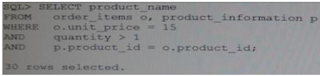
You generated the execution plan for the following query in the plan table and noticed that the nested loop join was done. After actual execution of the query, you notice that the hash join was done in the execution plan:
a)The optimizer used a dynamic plan for the query
b)The optimizer chose different plans because automatic dynamic sampling was enabled.
c)The optimizer used re-optimization cardinality feedback for the query
d)The optimizer chose different plan because extended statistics were created for the column used.
Question 36
You are the DBA supporting an Oracle 11g Release 2 database and wish to move a table containing several DATE, CHAR, VARCHAR2 and NUMBER data types, and the table's indexes, to another tablespace.
The table does not have a primary key and is used by an OLTP application
Which technique will move the table and indexes while maintaining the highest level of availability to the application?
a)Oracle Data Pump
b)An ALTER TABLE MOVE to move the table and ALTER INDEX REBUILD to move the indexes
c)An ALTER TABLE MOVE to move the table and ALTER INDEX REBUILD ONLINE to move the indexes
Question 38
Examine the details of the Top 5 Timed Events in the following AWR report?

What are three possible causes for the latch-related wait events?
a)The size of the shared pool is too small
b)Cursors are not being shared
c)A large number of COMMITS are being performed
d)There are frequent logons and logoffs
e)The buffers are being read into the buffer cache. but some other session is changing the buffers.
Question 39
Which statement is true about EM express in oracle 12c?
a)By default, EM express is available for a database after database creation
b)You can use EM express to manage multiple databases running on the same server
c)You can perform basic administrative tasks for pluggable databases by using the EM express interface
d)You can not startup or shut down a database instance by using EM express
e)You can create and configure pluggable databases by using EM express.
Question 40
Examine the following command.
ALTER SYSTEM SET enable_ddl_logging=FALSE;
Which statement is true?
a)None of the DDL statemets are logged in the trace file
b)Only DDL commands that resulted in errors are logged in the alert log file
c)A new log xml file that contains the DDL statements is created, and the DDL command details are removed from the alert log file.
d)Only DDL commands that resulted in the creation of new database files are logged.
Question 41
What is the result of executing a TRUNCATE TABLE command on a table that has Flashback Archiving enabled?
a)It fails with the ORA-665610 Invalid DDL statement on history-tracked message
b)The rows in the table are truncated without being archived
c)The rows in the table are archived, and then truncated
d)The rows in both the table and the archive are truncated.
Question 42
A warehouse fact table in your Oracle12c Database is range-partitioned by month and accessed
frequently with queries that span multiple partitions.
The table has a local prefixed, range partitioned index.
Some of these queries access very few rows in some partitions and all the rows in other partitions, but these queries still perform a full scan for all accessed partitions.
This commonly occurs when the range of dates begins at the end of a month or ends close to the start of month.
You want an execution plan to be generated that uses indexes access when only a few rows are accessed form a segment, while still allowing full scans for segments where many rows are returned.
Which three methods could transparently help to achieve this result?
a)Using a partial local index on the warehouse fact table month column with indexing disabled to the table partition that return most of their rows to the queries.
b)Using the partial local index on the warehouse fact table month column with indexing disabled for the table partition that return a few rows to the queries.
c)Using a partitioned view that does a UNION ALL query on the partitions of the warehouse fact table, which retains the existing local partitioned column.
d)Converting the partitioned table to a partitioned view that does a UNION ALL query on the monthly tables, which retains the existing local partitioned column.
e)Using the partial global index on the warehouse fact table month column with indexing disabling for the table partitions that return most of their rows to the queries.
f)Using a partial global index on the warehouse fact table month column with indexing for disabled for the table partition that return a few rows to the queries.
Question 43
Your upgraded your database from pre-12c to a multitenant container database(CDB)
containing pluggable database(PDBs).
Examine the query and its output.

Which two tasks must you perform to add users with SYSBAKCUP,SYSDG and SYSKM privilege to the password file?
a)Assign appropriate OS groups to SYSBAKCUP,SYSDG and SYSKM.
b)Grant SYSBAKCUP,SYSDG and SYSKM privilege to the intended users.
c)Re-create the password file with SYSBAKCUP,SYSDG and SYSKM privilege and the FORCE argument set to No.
d)Re-create the password file with SYSBAKCUP,SYSDG and SYSKM privilege, and FORCE arguments set to Yes.
e) Re-create the password file in the Oracle Database 12c format
Question 44
You Create a table with the PERIOD FOR clause to enable the use of the Temporal Validity features of Oracle Database 12c.
Examine the table definition.

Which three statements are true concerning the use of the Valid Time Temporal features for the EMPLOYEES table?
a) The Valid time columns employee_time_start and employee_time_end are automatically created.
b) The same statement may filter on both transaction time and valid temporal time by using the AS OF TIMESTAMP and PERIOD FOR clause.
c)The Valid time columns are not populated by the oracle server automatically
d)The valid time columns are visible by default when the table is described.
e)Setting the session valid time using DBMS_FLASHBACK_ARCHIVE_ENABLE_AT_VALID_TIME sets the visibility for DML , DDL and queries performed by the session.
Question 45
Which two statements are true concerning the Resource Manager plans for individual pluggable databases(PDB plans) in a multitenant container database(CDB)?
a)If no PDB plan is enabled for a pluggable database, then all sessions for that PDB are treated to an equal degree of the resource share of that PDB
b)In a PDB plan, subplans may be used with up to eight consumer groups
c)If a PDB plan is enabeld for a pluggable database, then resources are allocated to consumer groups across all PDBs in the CDB.
d)If no PDB plan is enabled for a pluggable database, then the PDB share in the CDB plan is dynamically calculated.
e)If a PDB plan is enabled for a pluggable database, then resources are allocated to consumer groups based on the shares provided to the PDB in the CDB plan and the shares provided to the consumer groups in the PDB plan.
Question 46
Your Database supports a DSS workload that involves the execution of complex queries. Currently, the library cache contains the ideal workload for analysis. You want to analyze some of the queries for an application that are cached in the library cache.
What must you do to receive recommendations about the efficient use of indexes and materialized views to improve query performance?
a)Create a SQL Tuning Set (STS) that contains the queries cached in the library cache and run the SQL Tuning Advisor(STA) on the workload captured in the STS.
b)Run the Automatic workload Repository Monitor(ADDM)
c)Create an STS that contains the queries cached in the library cache and run the SQL performance analyzer (SPA) on the workload captured in the STS.
d)Create an STS that contains the queries cached in the library cache and run the SQL access advisor on the workload captured in the STS

Question 49

Question 54
Question 61
You created an encrypted tablespace.

You then closed the encryption wallet because you were advised that this is secure.
Later in the day, you attempt to create the EMPLOYEES table in the SECURESPACE tablespace with the SALT option on the EMPLOYEE column.
Which is true about the result?
a)It creates the table successfully but does not encrypt any inserted data in the EMPNAME column because the wallet must be opened to encrypt columns with SALT.
b) It generates an error when creating the table because the wallet is closed
c) It creates the table successfully, and encrypts any inserted data in the EMPNAME column because the wallet needs to be open only for tablespace creation.
e)It generates error when creating the table, because the salt option cannot be used with encrypted tablespaces.
Question 63

Question 85
You plan to Migrate your database from a file system to ASM on same platform.
Which two methods or commands would you use to accomplish this task?
a)RMAN convert command
b)Data Pump Export and import
c)Conventional Export and Import
d)The BACKUP AS COPY DATABASE... command of RMAN
e)DBMS_FILE_TRANSFER with transportable tablespace
Question 21
Which two statements are true about the RMAN validate database command?
a)It checks the database for intrablock corruptions
b)It can detect corrupt pfiles
c)It can detect corrupt spfiles
d)It checks the database for interblock corruptions
e)It can detect corrupt block change tracking files
Question 22
Your multitenant container database, CDB1, is running in ARCHIVELOG mode and has two pluggable databases, HR_PDB and ACCOUNTS_PDB. An RMAN backup exists for the database.
You issue the command to open ACCOUNTS_PDB and find that the USERDATA.DBF data file for the default permanent tablespace USERDATA belonging to ACCOUNTS_PDB is corrupted.
What should you do before executing the commands to retore and recover the data in ACCOUNTS_PDB?
a)Place CDB1 in the mount stage and then the USERDATA tablespace offline in ACCOUNTS_PDB
b)Place CDB1 in the mount stage and issue the
ALTER PLUGGABLE DATABASE accounts_pdb CLOSE IMMEDIATE command.
c)Issue the ALTER PLUGGABLE DATABASE accounts_pdb RESTRICTED command
d)Take the USERDATA tablespace offline in ACCOUNTS_PDB
Question 23
You use a recovery catalog for maintaining your database backups.
You execute the following command:
$rman TARGET/CATALOG rman/cat@catdb
RMAN> BACKUP VALIDATE DATABASE ARCHIVELOG ALL;
Which two statements are true?
a)Corrupted blocks, if any are repaired
b)Checks are performed for physical corruptions
c)Checks are performed for logical corruptions
d)Checks are performed to confirm whether all database files exists in correct locations
e)backup sets containing both data files and archive logs are created.
Question 24
You notice a performance change in your production oracle database and you want to know which change has made this performance difference.
You generate the compare period Automatic Database Diagnostic Monitor(ADDM) report to further investigation.
Which three findings would you get from the report?
a)It detects any configuration change that caused a performance difference in both time period.
b)It identifies any workload change that caused a performance difference in both time period.
c)It detects the top wait events causing performance degradation.
d)It shows the resource usage for CPU, memory, and I/O in both time periods.
e)It shows the difference in the size of memory pools in both time period,
f)It gives information about statistics collection in both time periods.
Question 25
Which three statements are true about SQL plan directives?
a)They are tied to specific statement or SQL ID.
b)They instruct the maintenance job to collect missing statistics or perform dynamic sampling to generate a more optimal plan.
c)They used to gather only missing statistics.
d)They are created for a query expression where statistics are missing or the cardinality estimates by the optimizer are incorrect.
e)They instruct the optimizer to create only column group statistics.
f)Improve plan accuracy by persisting both compilation and execution statistics in the SYSAUX tablespace.
Question 26
Which four actions are possible during an online Data file Move operations?
a)Creating and dropping tables in the data file being moved.
b)Performing file shrink of the data file being moved.
c)Querying tables in the data file being moved.
d)Performing Block Media Recovery for a data block in the data file being moved.
e)Flashing back the database
f)Executing DML statements on objects stored in the data file being moved.
Question 27

a)Fine Grained Auditing(FGA) is enabled for the PRICE column in the PRODUCT tables for SELECT statements only when a row with PRICE > 10000 is accessed.
b)FGA is enabled for the PRODUCTS.PRICE column and an audit record is written whenever a row with PRICE>10000 is accessed.
c)FGA is enabled for all DML operations by JIM on the PRODUCTS.PRICE column.
d)FGA is enabled for the PRICE column of the PRODUCTS table and the SQL statements are captured in the FGA audit trail.
Question 28
You are administering a database stored in ASM. You use RMAN to backup the database and the MD_BACKUP command to backup the ASM metadata regularly. You lost an ASM disk group DG1 due to hardware failure.
In which three ways can you re-create the lost disk group and restore the data?a)Use the MD_RESTORE command to restore metadata for an existing disk group by passing the existing disk group name as an input parameter and use RMAN to restore the data.
b)Use the MKDG command to restore the disk group with the same configuration as the backed -up disk group and data on the disk group.
c)Use the MD_RESTORE command to restore the disk group with the changed disk group specification, failure group specification name, and other attributes and use RMAN to restore the data.
d)Use the MKDG command to restore the disk group with the same configuration as the backed-up disk group name and same set of disks and failure group configuration, and use RMAN to restore the data.
e)Use the MD_RESTORE command to restore both the metadata and data for the failed disk group.
f)Use the MKDG command to add a new disk group DG1 with the same or different specifications for failure group and other attributes and use RMAN to restore the data.
Question 29

Which three statements are true about the process of automatic optimization by using cardinality feedback?
a)The optimizer automatically changes a plan during subsequent execution of a SQL statement if there is a huge difference in optimizer estimates and execution statistics.
b)The optimizer can re optimize a query only once using cardinality feedback.
c)The optimizer enables monitoring for cardinaltiy feedback after the first execution of a query.
d)The optimizer does not monitor cardinality feedback if dynamic sampling and multicolumn statistics are enabled.
e)After the optimizer identifies a query as a re-optimization candidate, statistics collected by the collectors are submitted to the optimizer.
Question 30
You have altered a non-unique index to be invisible to determine if queries execute within an acceptable response time without using this index,Which two are possible if table updates are performed which affect the invisible index columns?
a)The index remains invisible
b)The index is not updated by the DML statements on the indexed table
c)The index automatically becomes visible in order to have it updated by DML on the table.
d)The index becomes unusable but the table is updated by DML
e)The index is updated by the DML on the table.
Question 31
Which three are direct benefits of the multiprocess, multithreaded architecture of Oracle Database 12c when it is enabled?
a)Reduced Logical I/O
b)Reduced virtual memory utilization
c)Improved Parallel Execution performance
d)Improved Serial Execution Performance
e)Reduced Physical I/O
f)Reduced CPU utilization
Question 32
You are using SQL Plus to the root container of a multitenant container database(CDB) with SYSDBA privilege.
The CDB has several pluggable databases(PDB's) open in the read/write mode.
There are ongoing transactions in both the CDB and PDBs
What happens after issuing the SHUTDOWN TRANSACTIONAL statement?
a) The shutdown proceeds immediately. The shutdown proceeds as soon as all transactions in the PDB's are either committed or rolled back.
b)The shutdown proceeds as soon as all transactionals in the CDB are either committed or rolledback.
c)The shutdown proceeds as soon as all transactions in both the CDB and PDBs are either committed or rolled back.
d)The statement results in an error because there are open PDBs
Question 33
Which two statements are true about the use of the procedures listed in the v$sysaux_occupants.move_procedure column?
a)The procedure may be used for some components to relocate component data to the SYSAUX tablespace from its current tablespace.
b)The procedure may be used for some components to relocate component data from the SYSAUX tablespace to another tablespace.
c)All the components may be moved into SYSAUX tablespace
d)All the components may be mvoed from the SYSAUX tablespace.
Question 34
User SCOTT has been granted the CREATE SESSION privilege and the MGR role.Which two statements are true when a session logged in as SCOTT queries the SAL column in the view and the table?
a) Data is redacted for the EMP.SAL column only if the SCOTT session does not have the MGR role set.
b)Data is redacted for EMP.SAL column only if the SCOTT session has the MGR role set.
c)Data is never redacted for the EMP_V.SAL column
d)Data is redacted for the EMP_V.SAL column only if the SCOTT session has the MGR role set.
e)Data is redacted for the EMP_V.SAL column only if the SCOTT session does not have the MGR role set.
Question 35
Examine the parameter for your database instance.

You generated the execution plan for the following query in the plan table and noticed that the nested loop join was done. After actual execution of the query, you notice that the hash join was done in the execution plan:

a)The optimizer used a dynamic plan for the query
b)The optimizer chose different plans because automatic dynamic sampling was enabled.
c)The optimizer used re-optimization cardinality feedback for the query
d)The optimizer chose different plan because extended statistics were created for the column used.
Question 36
You are the DBA supporting an Oracle 11g Release 2 database and wish to move a table containing several DATE, CHAR, VARCHAR2 and NUMBER data types, and the table's indexes, to another tablespace.
The table does not have a primary key and is used by an OLTP application
Which technique will move the table and indexes while maintaining the highest level of availability to the application?
a)Oracle Data Pump
b)An ALTER TABLE MOVE to move the table and ALTER INDEX REBUILD to move the indexes
c)An ALTER TABLE MOVE to move the table and ALTER INDEX REBUILD ONLINE to move the indexes
d)Online Table Redefinition
e)Edition-Based Table Redefinition
Question 37
Which two partitioned table maintenance operations support asynchronous Global index Maintenance in Oracle database 12c?
a)ALTER TABLE SPLIT PARTITION
b)ALTER TABLE MERGE PARTITION
c)ALTER TABLE TRUNCATE PARTITION
d)ALTER TABLE ADD PARTITION
e)ALTER TABLE DROP PARTITION
f)ALTER TABLE MOVE PARTITION
Question 38
Examine the details of the Top 5 Timed Events in the following AWR report?

What are three possible causes for the latch-related wait events?
a)The size of the shared pool is too small
b)Cursors are not being shared
c)A large number of COMMITS are being performed
d)There are frequent logons and logoffs
e)The buffers are being read into the buffer cache. but some other session is changing the buffers.
Question 39
Which statement is true about EM express in oracle 12c?
a)By default, EM express is available for a database after database creation
b)You can use EM express to manage multiple databases running on the same server
c)You can perform basic administrative tasks for pluggable databases by using the EM express interface
d)You can not startup or shut down a database instance by using EM express
e)You can create and configure pluggable databases by using EM express.
Question 40
Examine the following command.
ALTER SYSTEM SET enable_ddl_logging=FALSE;
Which statement is true?
a)None of the DDL statemets are logged in the trace file
b)Only DDL commands that resulted in errors are logged in the alert log file
c)A new log xml file that contains the DDL statements is created, and the DDL command details are removed from the alert log file.
d)Only DDL commands that resulted in the creation of new database files are logged.
Question 41
What is the result of executing a TRUNCATE TABLE command on a table that has Flashback Archiving enabled?
a)It fails with the ORA-665610 Invalid DDL statement on history-tracked message
b)The rows in the table are truncated without being archived
c)The rows in the table are archived, and then truncated
d)The rows in both the table and the archive are truncated.
Question 42
A warehouse fact table in your Oracle12c Database is range-partitioned by month and accessed
frequently with queries that span multiple partitions.
The table has a local prefixed, range partitioned index.
Some of these queries access very few rows in some partitions and all the rows in other partitions, but these queries still perform a full scan for all accessed partitions.
This commonly occurs when the range of dates begins at the end of a month or ends close to the start of month.
You want an execution plan to be generated that uses indexes access when only a few rows are accessed form a segment, while still allowing full scans for segments where many rows are returned.
Which three methods could transparently help to achieve this result?
a)Using a partial local index on the warehouse fact table month column with indexing disabled to the table partition that return most of their rows to the queries.
b)Using the partial local index on the warehouse fact table month column with indexing disabled for the table partition that return a few rows to the queries.
c)Using a partitioned view that does a UNION ALL query on the partitions of the warehouse fact table, which retains the existing local partitioned column.
d)Converting the partitioned table to a partitioned view that does a UNION ALL query on the monthly tables, which retains the existing local partitioned column.
e)Using the partial global index on the warehouse fact table month column with indexing disabling for the table partitions that return most of their rows to the queries.
f)Using a partial global index on the warehouse fact table month column with indexing for disabled for the table partition that return a few rows to the queries.
Question 43
Your upgraded your database from pre-12c to a multitenant container database(CDB)
containing pluggable database(PDBs).
Examine the query and its output.

Which two tasks must you perform to add users with SYSBAKCUP,SYSDG and SYSKM privilege to the password file?
a)Assign appropriate OS groups to SYSBAKCUP,SYSDG and SYSKM.
b)Grant SYSBAKCUP,SYSDG and SYSKM privilege to the intended users.
c)Re-create the password file with SYSBAKCUP,SYSDG and SYSKM privilege and the FORCE argument set to No.
d)Re-create the password file with SYSBAKCUP,SYSDG and SYSKM privilege, and FORCE arguments set to Yes.
e) Re-create the password file in the Oracle Database 12c format
Question 44
Examine the table definition.

Which three statements are true concerning the use of the Valid Time Temporal features for the EMPLOYEES table?
a) The Valid time columns employee_time_start and employee_time_end are automatically created.
b) The same statement may filter on both transaction time and valid temporal time by using the AS OF TIMESTAMP and PERIOD FOR clause.
c)The Valid time columns are not populated by the oracle server automatically
d)The valid time columns are visible by default when the table is described.
e)Setting the session valid time using DBMS_FLASHBACK_ARCHIVE_ENABLE_AT_VALID_TIME sets the visibility for DML , DDL and queries performed by the session.
Question 45
Which two statements are true concerning the Resource Manager plans for individual pluggable databases(PDB plans) in a multitenant container database(CDB)?
a)If no PDB plan is enabled for a pluggable database, then all sessions for that PDB are treated to an equal degree of the resource share of that PDB
b)In a PDB plan, subplans may be used with up to eight consumer groups
c)If a PDB plan is enabeld for a pluggable database, then resources are allocated to consumer groups across all PDBs in the CDB.
d)If no PDB plan is enabled for a pluggable database, then the PDB share in the CDB plan is dynamically calculated.
e)If a PDB plan is enabled for a pluggable database, then resources are allocated to consumer groups based on the shares provided to the PDB in the CDB plan and the shares provided to the consumer groups in the PDB plan.
Question 46
Your Database supports a DSS workload that involves the execution of complex queries. Currently, the library cache contains the ideal workload for analysis. You want to analyze some of the queries for an application that are cached in the library cache.
What must you do to receive recommendations about the efficient use of indexes and materialized views to improve query performance?
a)Create a SQL Tuning Set (STS) that contains the queries cached in the library cache and run the SQL Tuning Advisor(STA) on the workload captured in the STS.
b)Run the Automatic workload Repository Monitor(ADDM)
c)Create an STS that contains the queries cached in the library cache and run the SQL performance analyzer (SPA) on the workload captured in the STS.
d)Create an STS that contains the queries cached in the library cache and run the SQL access advisor on the workload captured in the STS
Question 47
Examine the contents of the SQL Loader control file :

Which three statements are true regarding the SQL * Loader operation performed using the control file?
a)An EMP table is created if a table does not exist. Otherwise, if the EMP table is appended with the loaded data.
b)The SQL * Loader data file myfile1.data has the column names for the EMP table.
c)The SQL * Loader operation fails because no record terminators are specified
d) Field names should be the first line in the both the SQL * Loader data files
Question 48
An Administrator Account is granted the CREATE SESSION and SET CONTAINER system privileges.
A multitenant container database (CDB) instant has the following parameter set :
THREADED_EXECUTION = FALSE
Which four statements are true about this administrator establishing connections to root in a CDB that has been opened in read only mode?
a) You can connect as a common user by using the connect statement
b) You can connect as a local user by using the connect statement
c) You can connect by using easy connect
d) You can connect by using OS authentication
e) You can connect by using a Net Service name
f) You can connect as a local user by using the SET CONTAINER statement.
Question 49
Which three tasks can be automatically performed by the automatic Data optimization feature of information life cycle management (ILM)?
a) Tracking the most recent read time for a table segment in a user tablespace
b) Tracking the most recent write time for a table segment in a user tablespace
c) Tracking insert time by row for table rows
d) Tracking the most recent write time for table block.
e) Tracking the most recent read time for a table segment in a SYSAUX tablespace
f) Tracking the most recent write time for a table segment in a SYSAUX tablespace
Question 50
Which three are true about the large pool for an oracle database instance that supports shared server connections?
a) Allocate memory for RMAN backup and restore operations
b) Allocate memory for shared and private SQL areas
c) Contains a cursor area for storing runtime information about cursors
d) Contains stack space
e) Contains a hash area performing hash joins of tables
Question 51
You want to flash back a test database by five hours.
You issue this command:
SQL > FLASHBACK DATABASE TO TIMESTAMP (SYSDATE-5/24);
Which two statements are true about this flashback scenario?
a) The database must have multiplexed redo logs for the flashback to succeed.
b) The database must be MOUNTED for the flashback to succeed
c) The database must use block change tracking for the flashback to succeed
d) The database must be opened in restricted mode for the flashback to succeed.
e) The database must be opened with the RESETLOGS option after the flashback is complete
f) The database must be opened in read-only mode to check if the database has been flashed back to the correct SCN
Question 52
Examine the query and its output executed in an RDBMS instance.

Which three statements are true about the users(other than sys) in the output?
A)The C ## B_ADMIN user can perform all backup and recovery operations using RMAN only.
B)The C ## B_ADMIN user can perform the data guard operation with data guard broker
C)The C ## B_ADMIN user can perform wallet operations
D)The C ## B_ADMIN user can perform backup and recovery operations for ASM
E)The C ## B_ADMIN user can perform all backup and recovery operations using RMAN or SQL * Plus
Question 53
You are connected to a pluggable database(PDB) as a common user with DBA privileges.
The STATISTICS_LEVEL parameter is PDB_MODIFIABLE. You execute the following :
SQL> ALTER SYSTEM SET STATISTICS_LEVEL = ALL SID = ‘*’ SCOPE = SPFILE;
Which is true about the result of this command?
a)The STATISTICS_LEVEL parameter is set to ALL whenever this PDB is re-opened.
b)The STATISTICS_LEVEL parameter is set to ALL whenever any PDB is reopened.
c)The STATISTICS_LEVEL parameter is set to ALL whenever the multitenant container database(CDB) is restarted.
d)Nothing happens, because there is no SPFILE for each PDB, the statement is ignored.
Question 54
You upgraded from a previous Oracle database version to Oracle Database 12c. Your database supports a mixed workload. During the day, lots of insert, update, delete operations are performed. At night, Extract, Transform, Load(ETL) and batch reporting jobs are run. The ETL jobs perform certain database operations using two or more concurrent sessions.
After the upgrade, you notice that the performance of ETL jobs has degraded. To ascertain the cause of performance degradation, you want to collect basic statistics such as the level of parallelism, total database time, and the number of I/O requests for the ETL jobs.
How do you accomplish this?
a)Examine the ASH reports for the time period of the ETL or batch reporting runs
b)Enable SQL tracing for the queries in the ETL and batch reporting queries and gather diagnostic data from the trace file
c)Enable real-time SQL monitoring for ETL jobs and gather diagnostic data from the V$SQL_MONITOR view
d)Enable real-time database operation monitoring using the DBMS_SQL_MONITOR.BEGIN_OPERATION function, and then use the DBMS_SQL_MONITOR.REPORT_SQL_MONITOR function to view the required information.
Question 55
Your database is open and the LISTENER listener running. You stopped the wrong listener LISTENER by issuing the following command.
lsnrctl> STOP
What happens to the session that are presently connected to the database instance?
a)They are able to perform only queries
b)They are not affected and continue to function normally
c) They are terminated and the active transactions are rolled back
d)They are not allowed to perform any operations until the listener LISTENER is started
Question 56
Examine the following command:
CREATE TABLE (prod_id number(4),
prod_name varchar2(20),
category_id number(30),
quantity_on_hand number(3) INVISIBLE);
Which three statements are true about using an invisible column in the PRODCTS table?
a)The %ROWTYPE attribute declarations in PL/SQL to access a row will not display the invisible column in the output.
b)The DESCRIBE commands in SQL * Plus will not display the invisible column in the output.
c)Referential integrity constraint cannot be set on the invisible column
d)The invisible column cannot be made visible and can only be marked as unused
e)A primary key constraint can be added on the invisible column.
Question 57
A senior DBA asked you to execute the following command to improve the performance.
SQL> ALTER TABLE subscribe log STORAGE(BUFFER_POOL recycle);
You checked the data in the SUBSRIBE_LOG table and found that it is a large table containing one million rows.
What could be a reason for this recommendation?
a)The keep pool is not configured.
b)Automatic workarea management is not configured
c)Automatic shared memory management is not enabled
d)The data blocks in the SUBSCRIBE_LOG table are rarely accessed
e)All the queries on the SUBSCRIBE_LOG table are rewritten to materialized view
Question 58
Your multitenant container (CDB) containing three pluggable databases (PDBs) is running in ARCHIVELOG mode. You find that the SYSAUX tablespace is corrupted in the root container.
The steps to recover the tablespace are as follows.
1.Mount the CBD
2.Close all the PDBs
3.Open the database
4.Apply the archive redo logs
5.Restore the data file
6.Take the SYSAUX tablespace offline
7.Place the SYSAUX tablespace online
8.Open all the PDBs with RESETLOGS
9.Open the database with RESETLOGS
10.Execute the command SHUTODWN ABORT
Which option identifies the correct sequence to recover the SYSAUX tablespace?
a) 6, 5, 4, 7
b) 10, 1, 2, 5, 8
c) 10, 1, 2, 5, 4, 9, 8
d) 10, 1, 5, 8, 10
Question 59
You are administering a database stored in ASM. The files are stored in the DATA disk group. You execute the following command :
SQL> ALTER DISKGROUP data ADD ALIAS ‘+data/prod/myfile.dbf’ FOR ‘+data/prod/myfile.dbf’
What is the result?
a)The file ‘+data.231.54769’ is physically relocated to ‘+data/prod’ and renamed as ‘myfile.dbf’
b)The file ‘+data.231.54769’ is renamed as ‘myfile.dbf’, and copied to ‘+data/prod’
c)The file ‘+data.231.54769’ remains in the same location and a synonym ‘myfile.dbf’ is created.
e)The file ‘+data.231.54769’ is created in ‘+data/prod’ and the reference to ‘+data.231.54769’ in the data dictionary removed.
Question 60
Identify there scenarios in which you would recommend the use of SQL performance Analyzer to analyze impact on the performance of SQL statements.
a)Change in the Oracle database version
b)change in your network infrastructure
c)Change in the hardware configuration of the database server
d)Migration of database storage from non-ASM to ASM storage
e)Database and operating system upgrade
Question 61
You created an encrypted tablespace.

You then closed the encryption wallet because you were advised that this is secure.
Later in the day, you attempt to create the EMPLOYEES table in the SECURESPACE tablespace with the SALT option on the EMPLOYEE column.
Which is true about the result?
a)It creates the table successfully but does not encrypt any inserted data in the EMPNAME column because the wallet must be opened to encrypt columns with SALT.
b) It generates an error when creating the table because the wallet is closed
c) It creates the table successfully, and encrypts any inserted data in the EMPNAME column because the wallet needs to be open only for tablespace creation.
e)It generates error when creating the table, because the salt option cannot be used with encrypted tablespaces.
Question 62
What are three purpose of the RMAN "FROM" clause?
a)To support
PUSH-based active database duplication
b)To support synchronization of a
standby database with the primary database in Data Guard Environment
c)To support
PULL-based active database duplication
d)To support file restores over the
network in a Data Guard environment
e)To support file recovery over the
network in a Data Guard environment.
Question 63
You performed an incremental level 0 backup of a database.
RMAN> BACKUP INCREMENTAL LEVEL 0 DATABASE;
To enable block change tracking after the incremental level
0 backup, you issued this command:
SQL>ALTER DATABASE ENABLE BLOCK CHANGE TRACKING USING
FILE ‘/mydir/rman_change_track.f’;
To perform an incremental level 1 cumulative backup, you
issued this command:
RMAN>BACKUP INCREMENTAL LEVEL 1 CUMULATIVE DATABASE;
Which three statements are true?
a)Backup change tracking will
sometimes reduce I/0 performed during cumulative incremental backups
b)The change
tracking file must always be backed up when you perform a full database backup
c)Block
change tracking will always reduce I/0 performed during cumulative incremental
backups
d)More than one database block may
be read by an incremental backup for a change made to single block.
e)The incremental level 1 backup
that immediately follows the enabling of block change tracking will not read
the change tracking file to discover changed blocks.
Question 64
Your multitenant container database (CBD) contains pluggable
database(PDBs), you are connected to the HR_PDB. You execute the following
command :
SQL>
CREATE UNDO TABLESPACE undotb01
DATAFILE
‘/u01/oracle/rddb1/undotbs01.dbf’ size
60m AUTOEXTEND ON;
What is the result?
a)It
executes successfully and creates an UNDO tablespace in HR_PDB
b)It
fails and reports and error because
there can be only one undo tablespace in CDB
c)It
fails and reports and error because the
CONTAINER=ALL clause is not specified in the command.
d) It
fails and reports and error because the
CONTAINER=CURRENT clause is not specified
in the command.
e) It executes successfully but
neither tablespace not the data file is created.
Question 65
In your multitenant container database(CDB) containing pluggable database(PDBs), you granted the CREATE TABLE privilege to the common user C##A_ADMIN in root and all PDBs.
You execute the following command from the root container.
SQL>REVOKE create table FROM C##A_ADMIN;
What is the result?
a)It executes successfully and the CREATE TABLE privilege is revoked from C##A_ADMIN in root only.
b)It fails and reports an error because the CONTAINER=ALL clause is not used.
c)It excludes successfully and the CREATE TABLE privilege is revoked from C##A_ADMIN in root and all PDBs.
d)It fails and reports an error because the CONTAINER=CURRENT clause is not used.
e)It executes successfully and the CREATE TABLE privilege is revoked from C##A_ADMIN in all PDBs.
Question 66
Which three statements are true about Flashback Database?
a)Flashback
logs are written sequentially, and are archived.
b) Flashback
Database uses a restored control file to recover the database.
c)The oracle database automatically
creates, deletes, and resides flashback logs in the fast recovery area.
d) Flashback database can recover a
database to the state that it was in before a reset logs operation.
e) Flashback
Database can recover a data file that was dropped during the span of time of
the flashback.
f)Flashback logs are used to restore
to the blocks before image, and then the redo data may be used to roll forward
to the desired flashback time
Question 67
In your database, you want to ensure that idle sessions that are blocking active are automatically terminated after a specified period of time.
How would you accomplish this?
a)Setting a metric threshold
b)Implementing Database resource manager
c)Enabling resumable timeout for user sessions
d)Decreasing the value of the IDLE_TIME resource limit in the default profile.
Question 68
Examine the following parameters for a database instance:
MEMORY_MAX_TARGET=0
MEMROY_TARGET=0
SGA_TARGET=0
PGA_AGGREGATE_TARGET=500m
Which three
initialization parameters are not controlled by ASMM?
a)LOG_BUFFER
b)SORT_AREA_SIZE
c)JAVA_POOL_SIZE
d)STREAMS_POOL_SIZE
e)DB_16K_CACHE_SIZE
f)DB_KEEP_CACHE_SIZE
Question 69
Your multitenant container database(CDB) is running in
ARCHIVELOG mode. You connect to the CBD RMAN.
Examine the following command and its output.

You execute the following command.
RMAN>BACKUP DATABASE PLUS ARCHIVELOG;
Which data files will be backed up?
a)Data files
that belong to only the root container
b)Data files that belong to the root
container and all the pluggable database(PDBs)
c)Data files
that belong to only the root container and PDB$SEED
d)Data files
that belong to the root container and all the PDBs excluding PDP$SEED
Question 70
You executed a DROP USER CASCADE on an Oracle11g release 1 database and immediately realized that you forgot to copy the OCA.EXAM_RESULT table to the OCP schema.
The RECYCLE_BIN enabled before the DROP USER was executed and the OCP user has been granted the FLASHBACK ANY TABLE system privilege.
What is the quickest way to recover the contents of the OCA.EXAM_RESULTS table to the OCP schema?
a)Execute FLASHBACK TABLE OCA.EXAM_RESULTS TO BEFORE DROP RENAME TO OC.EXAM_RESULTS; connect as SYSTEM.
b)Recover the table using traditional Tablespace point in time recovery.
c)Recover the table using Automated tablespace point in time recovery
d)Recover the table using Database Point in Time Recovery
e)Execute FLASHBACK TABLE OCA.EXAM_RESULTS TO BEFORE DROP RENAME TO EXAM_RESULTS; connected as a OCP user
Question 71
Question 72

The following are the possible steps to accomplish this task

Which two statements are true?


Question 84
In your multitenant container
database(CDB) containing pluggable database(PDBs), the HR user executes the
following commands to create and grant privileges on a
procedure:
CREATE OR REPLACE PROCEDURE create_test_v(v_emp_id
NUMBER, v_ename VARCHAR2, v_salary number, v_dept_id number)
BEGIN
INSERT INTO hr.test
values(v_emp_id,v_ename,v_salary, v_dept_id);
END;
/
GRANT EXECUTE ON CREATE_TEST TO john,
jim, smith, king;
How can you prevent users having the
EXECUTE privilege on the CREATE_TEST procedure from inserting values into
tables on which
they do not have any privileges?
a)Create the CREATE_TEST procedure
with definer’s rights
b)Grant EXECUTE privilege to users
with GRANT OPTION on the CREATE_TEST procedure
c)Create
the CREATE_TEST procedure with invoker’s rights
d)Create the CREATE_TEST procedure as part of a
package and grant users the EXECUTE privilege the packageQuestion 72
You notice a performance change in
your production Oracle12c database. You want to know which change caused this
performance difference.
Which method
or feature should you use?
a)Compare Period ADDM report
b)AWR
Compare period report
c)Active Session History(ASH) report
d)Taking a new snapshot and comparing it
with preserved snapshot
Question 73
The
tnsnames.ora file has an entry for the service alias ORCL as follows.

The TNS ping command executes
successfully when tested with ORCL; however, from the same OS user session, you
are not able to connect to the database
instance with the following command.
SQL>
CONNECT scott/tiger@orcl
What could be
the reason for this?
a)The listener is not running on the
database node
b)The TNS_ADMIN environment variable
is set to the wrong value
c)The
orcl.oracle.com database service is not registered with the listener.
d)The DEFAULT_DOMAIN parameter is set
to the wrong value in the sqlnet.ora file
e)The listener is running on a
different port
Question 74
You
administer an OLTP system whose database is stored in ASM and whose disk group
use normal redundancy.
One of the
ASM disk goes offline, and is then dropped because it was not brought online
before DISK_REPAIR_TIME elapsed.
When the disk
is replaced and added back to the disk group, the ensuing rebalance operation
is too slow.
Which two
recommendations should you make to speed up the rebalance operation if this
type of failure happens again?
a)Increase
the value of the ASM_POWER_LIMIT parameter
b)Set the DISK_REPAIR_TIME disk
attribute to a lower value
c)Specify
the statement that adds the disk back to the disk group
d)Increase the number of ASMB
processes
f)Increase the number of
DBWR_IO_SLAVES in the ASM instance.
Question 75
You are
required to migrate your 11.2.0.3 databases as a pluggable database(PDB) to a
multitenant container database(CBD).The following are the possible steps to accomplish this task
- Place all the user-defined tablespace in read-only mode on the source database
- Upgrade the source database to a 12c version
- Create a new PDB in the target container database
- Perform a full transportable export on the source database with the VERSION parameter set to 12 using the expdp utility.
- Copy the associated data files and export the dump file to the desired location in the target database.
- Invoke the Data Pump import utility on the new PDB database as a user with DATAPUMP_IMP_FULL_DATABASE role and specify the full transportable import options
- Synchronize the PDB on the target container database by using the DBMS_PDS.SYNC_ODB function
Identify the correct order of the required steps.
a)2, 1, 3, 4, 5, 6
b)1, 3, 4, 5, 6, 7
c)1, 4, 3, 5, 6, 7
d)2, 1, 3, 4, 5, 6, 7
e)1, 5, 6, 4, 3, 2
Question 76
You execute
the following commands to audit database activities:
SQL> ALTER SYSTEM SET
AUDIT_TRIAL=DB, EXTENDED SCOPE=SPFILE;
SQL>AUDIT SELECT TABLE, INSERT
TABLE, DELETE TABLE BY JOHN by SESSION WHENEVER SUCCESSFUL;
Which statement is true about the
audit record that generated when auditing after instance restarts?
a)One
audit record is created for every successful execution of a SELECT, INSERT OR
DELETE command on a table, and contains the SQL text for the SQL statement.
b) One audit record is created for
every successful execution of a SELECT, INSERT OR DELETE command, and contains
the execution plan for the SQL statements.
c) One audit record is created for the
whole session if john successfully executes a SELECT, INSERT or DELETE command, and contains the execution plan for
the SQL statements.
d) One audit record is created for the
whole session if JOHN successfully executes a select command, and contains the
SQL text and bind variables used.
e)One audit record is created for the
whole session if john successfully executes a SELECT, INSERT or DELETE
commands on a table, and contains the
execution plan, SQL text, and bind variable used.
Question 77
Which three
statements are true concerning the multitenant architecture?
a)Each pluggable database(PDB) has its
own set of background processes
b)A
PDB’s can have a private temp tablespace
c)PDBs can share the sysaux tablespace
d)Log
switches occur only at the multitenant container database(CDB) level
e)Different PDBs can have different
default block sizes
f)PDBs share a common system
tablespace
g)Instance
recovery is always performed at the CBD level
Question 78
Which three
operations can be performed as multi partition operations in Oracle?
a)Merge
partitions of a list partitioned tables
b)Drop
partitions of a list partitioned tables
c)coalesce partition of a
hash-partitioned global index
d)Move partitions of a range
partitioned tables
e) Rename partitions of a range
partitioned tables
f)Merge
partitions of a reference partitioned index
Question 79
In your multitenant container
database(CDB) containing same pluggable databases(PDBs), you execute the
following commands in the Root container.

Which two statements are true?
a)The
C##ROLE1 role is created in the root database and all the PDBs.
b)The C##ROLE1 role is created only in
the root database because the container clause is not used.
c)Privilege
are granted to the C##A_ADMIN user only in the root database
d)Privilege are granted to the
C##A_ADMIN user in the root database and all PDBs
e)The statement for granting a role to
user fails because the CONTAINER clause is not used
Question 80
Examine the
following steps of privilege analysis for checking and revoking excessive,
unused privileges granted to users:
1)Create a policy to capture the
privilege used by a user for privilege analysis
2)Generate a report with the data
captured for a specified privilege capture
3)Start analyzing the data captured by
the policy
4)Revoke the unused privileges
5)Compare the used and unused
privilege’s lists
6)Stop analyzing the data
Identify the correct
sequence of steps:
a)1, 3, 5, 6, 2, 4
b)1,
3, 6, 2, 5, 4
c)1, 3, 2, 5, 6, 4
e)1, 3, 5, 2, 6, 4
Question 81
Which two
statements are true about the Oracle Direct Network file system(DNFS)?
a)It utilize the OS file system cache
b)A Traditional NFS mount is not
required when using Direct NFS
c)Oracle
Disk Manger can manage NFS on its own, without using the operating kernel NFS
driver
d)Direct NFS is available only in UNIX
platforms
e)Direct
NFS can load-balance I/O traffic across multiple network adapters.
Question 82
You find this
query being used in your Oracle 12c database

Which method a used by the optimizer
to limit the rows being returned?
a)A filter is added to the table query
dynamically using ROWNUM to limit the rows to 20 percent of the total rows
b)All the rows are returned to the
client or middle tier but only the first 20 percent are returned to the screen
or the application
c)
A view is created during execution and a filter on the view limits the rows to
20 percent of the total rows
d)A TOP-N query is created to limit
the rows to 20 percent of the total rows
Question 83
You are
connected using SQL*plus to a multitenant container database(CBD) with SYSDBA
privilege and execute the following sequence statements :

What is the
result of the last SET CONTAINER statement and why is to so?
a)It succeeds because the PDB_ADMIN
user has the required privileges
b)It fails because common users are
unable to use the SET CONTAINER statement
c)It
fails because local users are unable to use the SET CONTAINER statement
Question 84
You are
administering a database and you receive a requirement to apply the following
restrictions:
1)A connection must be terminated
after four unsuccessful login attempts by user
2)A user should not be able to create
more than four simultaneous sessions
3)User session must be terminated
after 15 minutes of inactivity
4)Users must be prompted to change their
passwords every 15 days
How would you
accomplish these requirements?
a)By granting a secure application
role to the users
b)By creating and assigning a profile
to the users and setting the REMOTE_OS_AUTHENT parameter to FALSE
c)By
creating and assigning a profile to the users and setting the
SEC_MAX_FAILED_LOGIN_ATTEMPTS parameter to 4
d)By Implementing Fine-Grained
Auditing(FGA) and setting the REMOTE_LOGIN_PASSWORD_FILE parameter to NONE
e)By Implementing the database
resource manager plan and setting the SEC_MAX_FAILED_LOGIN_ATTEMPTS parameter
to 4
Question 85
You support
Oracle Database 12c Oracle Database 11g, and
Oracle database log on the same server.
All database
of all versions use ASM.
Which three
statements are true about the ASM disk group compatibility attributes that are
set for disk group?
a)The
ASM compatibility attribute controls the format of the disk group metadata
b)RDBMS
compatibility together with the database version determines whether a database
instance can mount the ASM disk group
c)The RDBMS compatibility setting
allows only database set to the same version as the compatibility value, to
mount the ASM disk group
d)The
ASM compatibility attribute determines some of the ASM features that may be
used by the Oracle disk group
e)The ADVM compatibility attribute
determines the ACFS features that may be used by the oracle10g database
Question 86
In a recent
AWR report for your database, you notice high number of buffer busy waits. The
database consists of locally managed tablespace with free list managed
segments.
On further
investigation, you find that buffer busy waits is caused by contention on data
blocks.
What option
would you consider first to decrease the wait event immediately?
a)Decreasing PCTUSED
b)Decreasing PCTFREE
c)Increasing the number of DBWR
process
d)Using
Automatic segment space management(ASSM)
e)Increasing db_buffer_cache based on
the V$DB_CACHE_ADVICE recommendation
Question 87
In order to
exploit some new storage tiers that have been provisioned by a storage
administrator, the partitions of large heap table must be moved to other
tablespaces in your Oracle12c database?
Both local
and global partitioned B-tree indexes are defined on the table
A high volume
of transactions access the table during the day and a medium volume of
transactions access at night and during weekends.
Minimal
distruption availability is required.
Which three
statements are true about this requirement?
a)The
partitions can be moved online to new tablespace
b)Global indexes must be rebuilt
manually after moving the partitions
c)The
partitions can be compressed in the same tablespaces
d)The
partitions can be compressed in the new tablespaces
e)Local indexes must be rebuilt
manually after moving the partitions
Question 88
To implement
Automatic Memory Management (AMM), you set the following parameters.
When you try
to start the database instance with these parameter settings, you receive the
following error message:
SQL>
startup
ORA-00824:
cannot set SGA_TARGET or MEMROY_TARGET due to existing internal settings, see
alert log for more information.
Identify the
reason the instance failed to start.
a)The PGA_AGGREGATE_TARGET parameter
is set to zero
b)The
STATISTICS_LEVEL parameter is set to BASIC
c)Both the SGA_TARGET and
MEMORY_TARGET parameters are set
d)The SGA_MAX_SIZE and SGA_TARGET
parameter values are not equal
Question 89
The redaction
policy was added to the SAL column of the SCOTT.EMP table

All users
have their default set of system privileges.
For which
three situations will data not be redacted?
a)SYS
sessions, regardless of the roles that are set in the session
b)
SYSTEM sessions, regardless of the roles that are set in the session
c)SCOTT sessions, only if the MGR role
is set in the session
d)SCOTT
sessions, only if the MGR role is granted to SCOTT
e)SCOTT sessions, because he is the
owner of the table
f)SYSTEM session, only if the MGR role
is set in the session
Question 90
Examine the
following impdp command to import a database over the network from a pre-12c
oracle database(source):

Which three
are prerequisites for successful execution of the command?
a)The
import operation must be performed by a user on the target database with the
DATAPUMP_IMP_FULL_DATABASE role, and the database link must connect to a user
on the source database with the DATAPUMP_EXP_FULL_DATABASE role.
b)All
the user-defined tablespaces must be in read-only mode on the source database
c)The export dump file must be created
before starting the import on the target database
d)The
source and target database must be running on the same platform with same
endianness
e)The path of data files on the target
database must be the same as that on the
source database
f)The impdp operation must be
performed by the same user that performed the expdp operation
Question 91
You install a
non-RAC oracle database, during installation, the oracle universal installer(OUI)
prompts you to enter the path of the inventory directory and also to specify an
operating system group name.
Which
statement is true?
a)The ORACLE_BASE base parameter is
not set
b)The installation is being performed
by the root user
c)The operating system group that is
specified should have the root user as its member
d)The
operating system group that is specified must have permission to write to the
inventory directory.
Question 92
Identify two situations
in which the alert log file is updated?
a)Running
a query on a table returns ORA-600: Internal Error.
b)Inserting a value into a table
returns ORA-01722: Invalid number
c)Creating a table returns ORA-00955:
name is already in used by an existing objects
d)Inserting a value into table returns
ORA-00001: unique constraint(SYS.OK_TECHP) violated
e)Rebuilding
an index using ALTER INDEX…REBUILD fails with an ORA-01578: ORACLE data block
corrupted(ifle#14, block#50) error
Question 93
Which
statement is true concerning dropping a pluggable database(PDB)?
a)The PDB must be open in read only
mode
b)The
PDB must be in mount state
c)The PDB must be unplugged
d)The PDB data files are always
removed from disk
e)A dropped PDB can never be plugged
back into a multitenant container database(CDB)
Question 94
Your
multitenant container database(CDB) contains three pluggable database(PDB). You
find that the control file is damaged. You plan to use RMAN to recover the
control file. There are no startup triggers associated with the PDBs.
Which three
steps should you perform to recover the control file and make the database
fully operational?
a)Mount the container database(CBD)
and restore the control file from the control file auto backup
b)Recover and open the CDB in NORMAL
mode
c)Mount
the CDB and then recover and open the database, with the RESETLOGS option
d)Open
all the pluggable database
e)Recover each pluggable database
f)Start
the database instance in the nomount stage and restore the control file from
control file auto backup.
Question 95
In which two
scenarios do you use SQL* Loader to load data?
a)Transform the data while it is being
loaded into the database
b)Use Transparent parallel processing
without having to split the external data first
c)Load
data into multiple tables during the same load statement
d)Generate
unique sequential key values in specified columns
Question 96
You use the
segment advisor to help determine objects for which space may be reclaimed.
Which three
statements are true about the advisor given by the segment advisor?
a)It
may advise the use of online table redefinition for tables in dictionary
managed tablespace
b)It may advise the use of segment
shrink for tables in dictionary managed tablespace it the no chained rows
c)It
may advise the use of online table redefinition for tables in locally managed tablespace
d)It
will detect and advise about chained rows
e)It may advise the use of segment shrink
for free list manage tables
Question 97
You enabled
an audit policy by issuing the following statements:
SQL> AUDIT
POLICY ORA_DATABASE_PARAMETER BY SCOTT;
SQL> AUDIT
POLICY ORA_DATABASE_PARAMETER BY SYS,SYSTEM;
For which
database users and for which executions
is the audit policy now active? Select Two.
a)SYS,SYSTEM
B)SCOTT
c)Only for successful exections
d)Only for failed executions
e)Both
successful and failed executions
Question 98
What is the
effect of specifying the “ENABLE PLUGGABLE DATABASE” clause in a “CREATE
DATABASE” statement?
a)It will create a multitenant
container database(CBD) with only the root opened
b)It
will create a CDB with root opened and seed read only
c)It will create a CDB with root and
seed opened and one PDB mounted
d)It will create a CDB that must be
plugged into an existing CDB
e)It will create a CDB with root
opened and seed mounted.
Question 99
You execute
the following command to create password file in the database server.
$orapwd file
= ‘+DATA/PROD/orapwprod entries = 5 ignorecase = N format = 12’
Which two
statements are true about the password file?
a)It records the usernames and
passwords of users when granted the DBA role.
b)It records the username and
passwords of users for whom auditing is enabled
c)Is
used by Oracle to authenticate users for remote database administration
d)It records the usernames and
passwords of all users when they are added to the OSDBA or OSOPER operating
system groups
e)
It supports the SYSBACKUP, SYSDG and SYSKM system privileges
Question 100
Which three
statements are true when the listener handles connection request to an Oracle
12c database instance with multithreaded architecture enabled in UNIX?
a)Thread
creation must be routed through a dispatcher process
b)The local listener may spawn a new
process and have that new process creates a thread
c)Each Oracle process runs an SCMN
thread
d)Each
multithreaded oracle process has an SCMN thread
e)The
local listener may pass the request to an existing process which in turn will
create a thread
